Your net‑metering bill, finally clear.
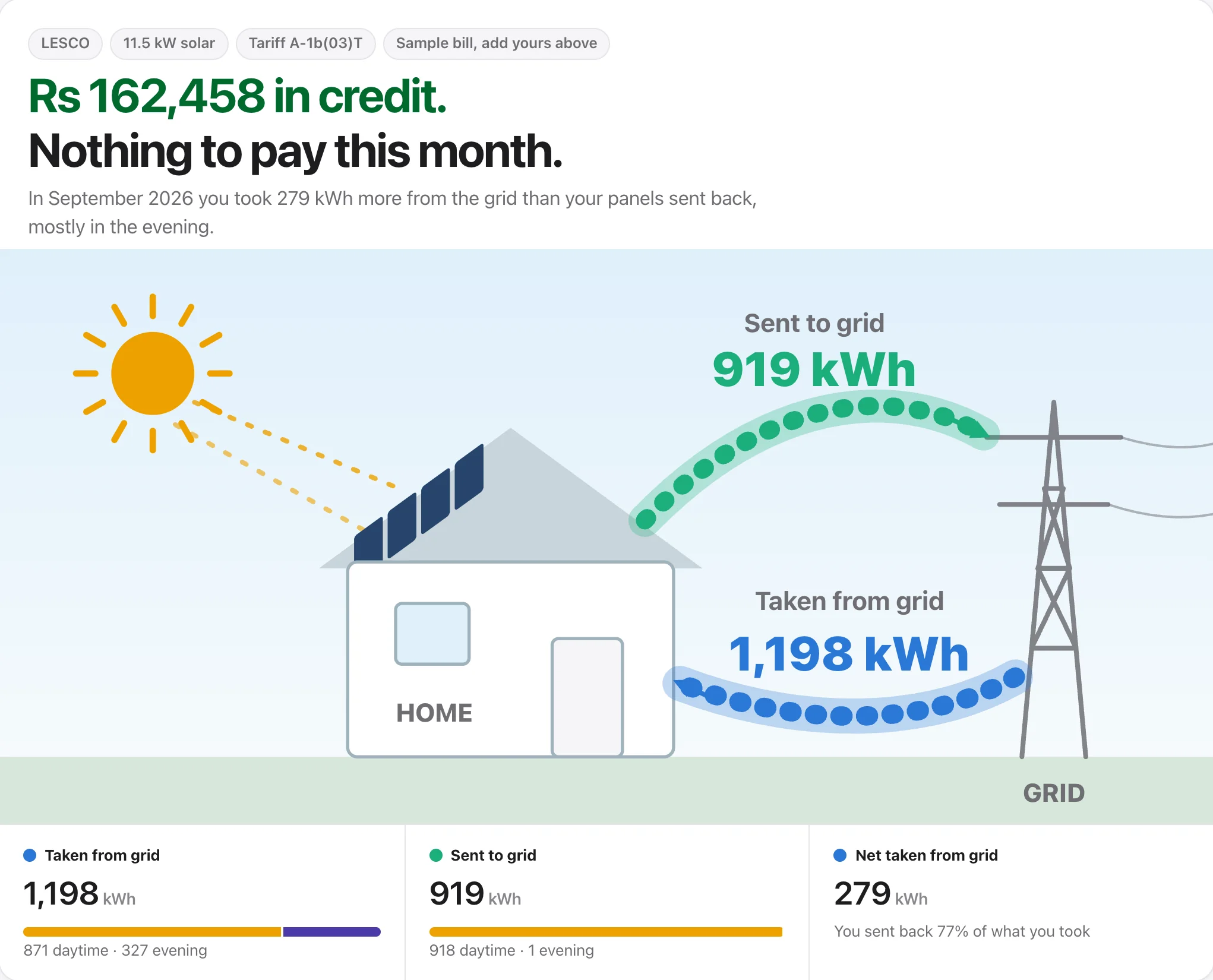
Add your electricity bill. See what your panels sent to the grid, what the evening cost you, and why a month with more exports than imports can still end in a bill.
Works with web bills from LESCO IESCO FESCO GEPCO MEPCO PESCO HESCO
More out than in.
Still a bill.
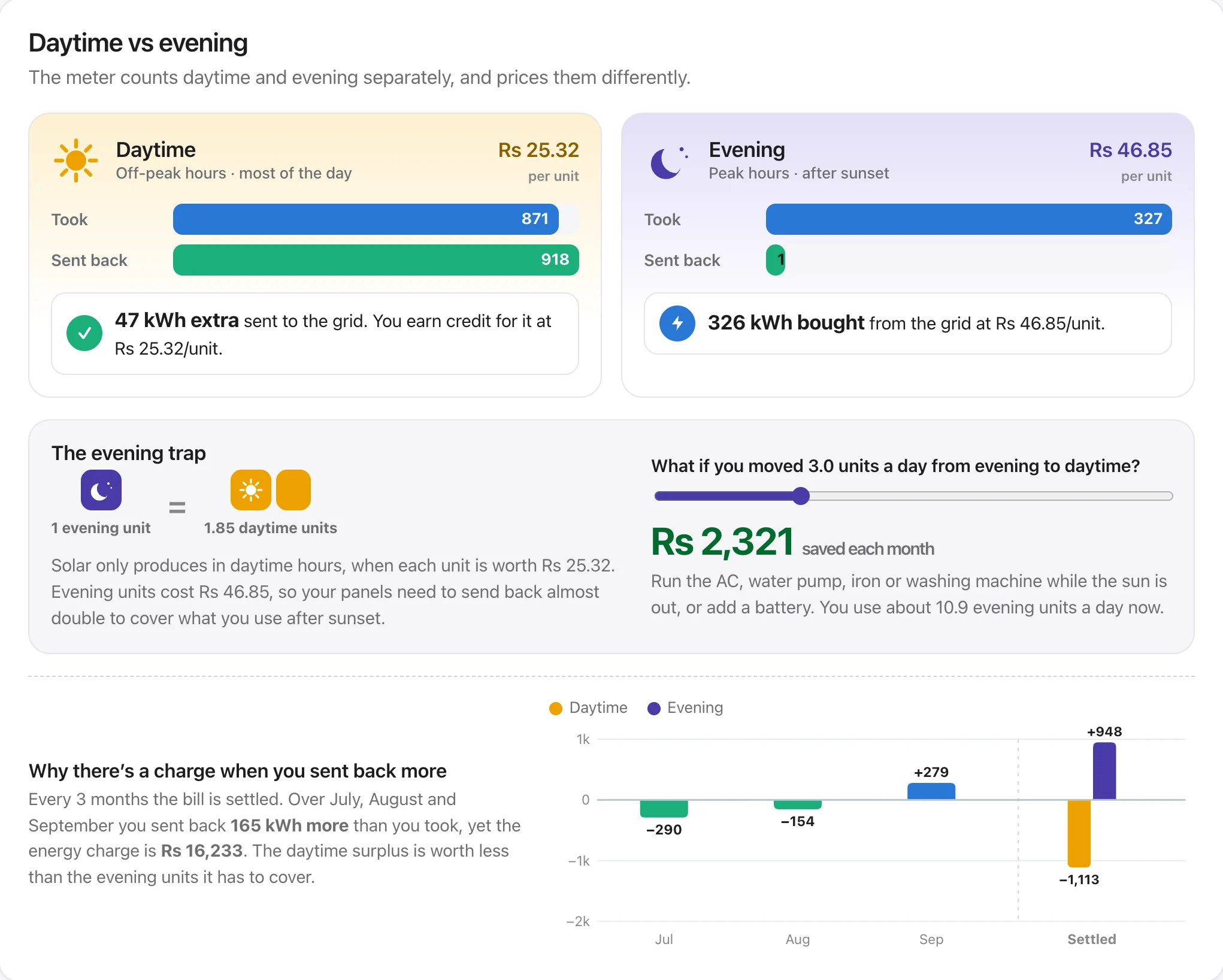
Net metering settles by value, not only by units. Evening imports are charged at the peak rate, surplus exports are credited at the off-peak rate, and fixed charges, fuel adjustment and taxes aren’t netted at all (PPIB guide for DISCOs). Each evening unit takes 1.85 daytime units to cancel.
Every line on your bill,
in plain words.
-
Where every unit went
Units taken from the grid and sent back, drawn as an energy flow, with the day and evening split for each.
-
What the evening cost
Your peak-hour share of the bill, and what moving a few units into daylight would save each month.
-
Credit that carries forward
Units rolled through the settlement cycle, where you are in it, and the balance on your account.
-
What solar saved you
Your bill with and without panels, how much you used directly, and a payback estimate.
-
A full bill check
Energy charge, GST, electricity duty and settlement recomputed, and the QR code matched against the print.
-
Every meter you look after
Home, shop, parents’ house. Bills are filed by consumer ID, with a reminder when the next one is out.
The two prices on every bill.
Your meter counts daytime and evening units separately, and your DISCO prices them differently. Solar Bill puts them side by side, shows how the quarter settled, and works out what shifting a few units would save.
Under a minute, start to finish.
Download your web bill
Open your DISCO’s online bill page, enter the reference number from your paper bill, and save it as a PDF.
Add it to Solar Bill
Choose the PDF, or a clear photo of its QR codes. It’s read on your device, and nothing is uploaded unless you save it.
Read it in plain words
What you sent, what you took, what it cost and what to change. Add next month’s bill to see the trend.
Your bill stays on your device.
Your consumer ID and address are on that PDF. Solar Bill reads it inside your browser, so trying it sends nothing to us.
- No account neededClose the tab and the bill is gone.
- Sign in with GoogleNo password. We receive only your email address.
- Yours to deleteDownload everything or delete it any time. Privacy
Net-metering bill terms, explained.
The labels in your bill’s net-metering box and QR code, in one line each.
- Import units
IMP - Electricity you took from the grid, mostly at night and in the evening.
- Export units
EXP - Surplus solar your panels sent to the grid during the day.
- Off-peak
OP - Every hour outside the evening peak window. Charged, and credited, at the lower rate.
- Peak
PK - A four-hour evening window, roughly 5–9 PM in winter to 7–11 PM in summer, charged at the higher rate.
- Net units
NET - Imports minus exports in each band. A minus sign means you sent more than you took.
- Month count
3/3 - Where this bill sits in the settlement cycle. Carried units are settled at the end of it.
- Carried-forward units
REMAINING - Surplus units rolled over from earlier months of the cycle.
- Buyback rate
- What the DISCO pays for surplus units. Reported at about Rs 25–26 for pre-2026 agreements.
- Green meter
- The bidirectional meter fitted for net metering. It records imports and exports separately.
- Net billing
- The 2026 system for new solar users: imports and exports are priced separately instead of netted.
Net metering in 2026: what changed.
NEPRA’s Prosumer Regulations changed the rules for new rooftop-solar users. Here is what that means for the bill in your hand.
- 9 February 2026
- Net billing replaces net metering for new applicants. Imports are billed at the full tariff and exports are bought back separately, at roughly Rs 8–11 per unit. New agreements run five years, and solar capacity is capped at your sanctioned load. (Dawn, Express Tribune)
- April 2026
- Existing users keep their terms. Consumers with a valid agreement on 9 February 2026 are billed under the earlier mechanism until it expires. Enlarging the system gives those terms up. (Profit)
- 466,000 consumers
- Pakistan had roughly 466,000 net-metering consumers and about 7,000 MW of grid-tied solar as of February 2026. (Profit)
- What Solar Bill reads
- Net-metering bills under the earlier terms, from the seven DISCOs above. Bills under the new net-billing rules are laid out and priced differently.
Updated 26 September 2026
Solar bill questions, answered.
Why did I get a bill when I exported more units than I imported?
Net metering is settled by value, not just units. Evening (peak) imports are charged at the peak rate, while surplus exports are credited at the off-peak rate, and fixed charges, fuel price adjustment and taxes are not netted against exports. So a household can export more units than it uses and still owe money.
On our sample LESCO bill, the quarter ended 165 units in credit but still carried an energy charge of Rs 16,233.
What are import and export units on a net-metering bill?
Import units are the electricity you draw from the grid, mostly at night and in the evening. Export units are the surplus your solar panels send to the grid during the day. Both are recorded by the bidirectional (green) meter and split into peak (PK) and off-peak (OP) registers.
Did net metering end in Pakistan in 2026?
For new applicants, yes. NEPRA’s Prosumer Regulations, notified on 9 February 2026, replaced net metering with net billing, where imports and exports are priced separately.
An amendment notified in April 2026 lets consumers with a valid agreement on 9 February 2026 keep their earlier terms until the agreement expires, as long as they do not enlarge their system.
What is the net-metering buyback rate in 2026?
Reports put the rate for existing (pre-February 2026) agreements at about Rs 25 to 26 per unit, and the rate for new net-billing prosumers at roughly Rs 8 to 11 per unit, linked to the national average energy purchase price. Your own bill shows the rates actually applied to you, and Solar Bill reads them for you.
What are peak hours on an electricity bill?
Peak hours are a four-hour evening window when electricity costs more. The window moves with the season, roughly 5 to 9 PM in winter and 7 to 11 PM in summer. Units you import in this window are billed at the peak rate.
What does MONTH COUNT 3/3 mean on my bill?
It shows where your bill falls in the settlement cycle. Surplus units are carried forward from month to month, and at the end of the cycle (3/3 on a quarterly cycle) the carried units are settled. That is why a bill at the end of a cycle can look very different from the months before it.
Which electricity companies does Solar Bill support?
Solar Bill reads net-metering web bills from LESCO, IESCO, FESCO, GEPCO, MEPCO, PESCO and HESCO, which share the PITC web-bill layout and QR codes. K-Electric bills use a different format and are not supported yet.
Is it safe to upload my electricity bill?
Without an account, your bill is read entirely inside your browser and nothing is sent to our servers. If you sign in with Google to save your bills, the PDF and its figures are stored privately under your account, and you can download or delete them at any time.
How do I get my net-metering bill PDF?
Open your DISCO’s online web-bill page, enter the 14-digit reference number or consumer ID printed on your paper bill, and save or print the bill as a PDF. Solar Bill also reads a clear photo of the bill’s QR codes.
Is Solar Bill free?
Yes. Checking a bill is free and needs no account. Signing in, also free, saves your bills by consumer ID, shows month-by-month trends and sends one reminder a month when your new bill is out.